Table of Content
- What is TRIBE v2?
- Why TRIBE v2 is a Breakthrough
- How TRIBE v2 Works
- The Power of a Digital Brain Model
- Real-World Applications of TRIBE v2
- Dataset and Training Innovation
- Open Access for Researchers
- Limitations of TRIBE v2
- TRIBE v2 vs Traditional Brain Models
- The Future of Brain-AI Integration
- TRIBE v2 – Frequently Asked Questions
Artificial Intelligence is no longer just about generating text or recognizing images. The next frontier is far more ambitious—understanding how the human brain actually works.
That’s exactly what Meta is trying to achieve with its latest breakthrough: TRIBE v2, a predictive foundation model designed to simulate how the human brain responds to complex stimuli like images, audio, and language.
This is not just another AI model. It represents a major step toward building systems that can think, perceive, and respond more like humans.
What is TRIBE v2?
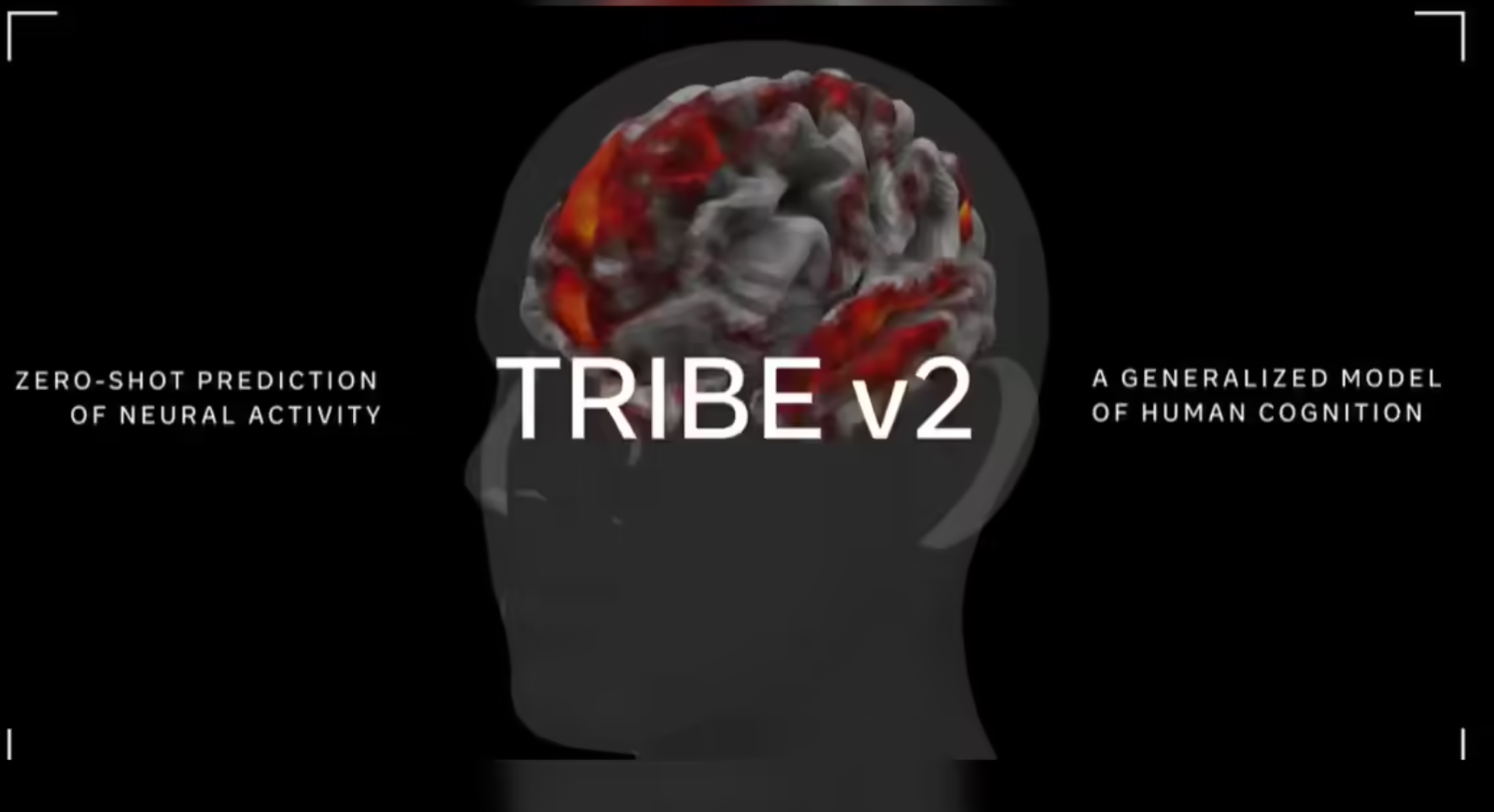
TRIBE v2 is an advanced AI model that predicts human brain activity in response to different types of input, including visual content, sound, and text.
In simple terms, it acts as a digital twin of human neural activity.
Instead of directly reading thoughts, TRIBE v2 analyzes patterns in brain scans and learns how the brain typically reacts to certain stimuli. Once trained, it can predict how a brain would respond—even for new inputs or individuals.
This makes it one of the most powerful tools in modern neuroscience and AI research.
Why TRIBE v2 is a Breakthrough
Understanding the human brain has always been one of the most complex challenges in science. TRIBE v2 brings several major improvements that push this field forward.
First, it delivers a 70x increase in resolution compared to previous models. This means it can capture brain activity in far greater detail.
Second, the model is trained on a massive dataset of over 700 participants, which significantly improves its accuracy and generalization.
Third, it supports zero-shot prediction, meaning it can predict brain responses for new subjects, languages, and tasks without needing additional training.
These improvements make TRIBE v2 not just an upgrade, but a major leap in brain-AI modeling.
How TRIBE v2 Works
At its core, TRIBE v2 is trained using fMRI (functional Magnetic Resonance Imaging) data.
Researchers collected brain activity data from hundreds of individuals while they were exposed to different types of media, including:
- Images
- Videos
- Podcasts
- Text
The model learns patterns between these inputs and the corresponding brain responses.
Once trained, it can take a new input—like a picture or a sentence—and predict how the human brain would react.
A simple way to understand this is:
Just like language models predict the next word in a sentence, TRIBE v2 predicts brain activity patterns based on sensory input.
The Power of a Digital Brain Model
One of the most exciting aspects of TRIBE v2 is its ability to function as a digital simulation of the human brain.
This allows researchers to:
- Test hypotheses without needing human subjects every time
- Run experiments faster and at scale
- Explore complex neural behaviors safely
Traditionally, neuroscience experiments are slow, expensive, and limited by the availability of participants. TRIBE v2 changes that by enabling computational experimentation.
Real-World Applications of TRIBE v2
The impact of TRIBE v2 extends across multiple industries and research fields.
1. Medical Research and Healthcare
TRIBE v2 could revolutionize how we study neurological disorders such as:
- Alzheimer’s disease
- Parkinson’s disease
- Brain injuries
By simulating brain responses, researchers can test treatments and understand conditions more deeply without invasive procedures.
2. Advancing Artificial Intelligence
Modern AI systems still struggle to replicate human-like perception.
By learning directly from brain activity, TRIBE v2 can help build:
- More human-like AI models
- Better visual and audio understanding systems
- Improved multimodal AI architectures
This could lead to AI that understands context and perception much closer to how humans do.
3. Neuroscience Research
TRIBE v2 provides a powerful tool for scientists to study how the brain processes complex stimuli.
Researchers can:
- Analyze how the brain reacts to different types of content
- Study cognitive processes like attention and memory
- Explore how different regions of the brain interact
4. Human-Computer Interaction
In the future, models like TRIBE v2 could enable more natural interaction between humans and machines.
This includes:
- Brain-computer interfaces
- Adaptive user experiences
- Personalized AI systems
Dataset and Training Innovation
One of the key strengths of TRIBE v2 is the scale and diversity of its training data.
The model was trained on data from more than 700 healthy participants, who were exposed to a wide range of media formats.
This includes:
- Visual content (images and videos)
- Audio content (podcasts)
- Text-based information
This diversity allows the model to understand how the brain responds to different types of stimuli, making it highly versatile.
Open Access for Researchers
Meta has made TRIBE v2 available to the research community by releasing:
- Model weights
- Codebase
- Research paper
- Interactive demo
This open approach is designed to accelerate innovation and allow scientists around the world to build on this work.
However, the release is under a non-commercial license, meaning it is primarily intended for research purposes.
Limitations of TRIBE v2
Despite its impressive capabilities, TRIBE v2 is still in its early stages.
It does not read thoughts directly or understand personal intentions. Instead, it predicts general patterns of brain activity.
The model also depends heavily on the quality and diversity of its training data. While 700 participants is a large dataset, it still cannot fully capture the complexity of all human brains.
Additionally, real-world applications, especially in medicine, will require extensive validation and testing.
TRIBE v2 vs Traditional Brain Models
Traditional neuroscience models often rely on simplified assumptions and limited datasets.
In contrast, TRIBE v2:
- Uses large-scale data
- Supports multiple input types
- Offers higher resolution predictions
- Generalizes better across subjects
This makes it significantly more powerful and flexible than older approaches.
The Future of Brain-AI Integration
TRIBE v2 represents an important step toward bridging the gap between artificial intelligence and human cognition.
In the future, we may see:
- AI systems trained directly on brain data
- Advanced brain-computer interfaces
- Personalized AI assistants that understand human perception
As research continues, models like TRIBE v2 could fundamentally change how we understand intelligence itself.
TRIBE v2 is more than just another AI model. It is a glimpse into a future where machines can understand the human brain at a deeper level.
By combining large-scale data, advanced modeling techniques, and neuroscience insights, Meta has created a system that pushes the boundaries of both AI and brain research.
While challenges remain, the potential impact of this technology is enormous.
From healthcare to AI development, TRIBE v2 could play a key role in shaping the next generation of intelligent systems.